Animal, Vegetable, Miracle: A Year of Food Life by Barbara Kingsolver (with Stephen L. Hopp and Camille Kingsolver) is a book about family: her family, the farming and agricultural family, and the family of men. (And it is written with her family - her daughter provides the recipes and nutrition segments, her husband, the food industry issues.) Can one family of four sustain themselves on locally grown food for a year? That is the question that Kingsolver and her family attempt to solve. It helps that they live on a farm in southwest Virginia, but they "survive" by growing and raising their own food, going to local farmer's markets and seeing where items are grown in their local stores. Her segment on turkey reproduction is very funny and scary. Funny - from her descriptions - scary, when you realize that certain breeds no longer reproduce naturally at all - it is bred out of the birds.
Do they make - sure. Is it easy? Not so much, but the tone in which Kingsolver writes just guides you through the seasons. She does not have the stridency of a convert, for she writes about their dilemmas and "must have" items (coffee for the adults, mac and cheese for the kids and their friends) with candidness. But she gives the reader hope that the food environment is changing-back to food grown in healthy ways for both the farmer and pickers and the eaters. And she provides resources and recipes to help the average folk contribute along their path. As someone who grew up with a large vegetable garden and canning, I really liked how she handled the whole topic of raising your own food. I was very impressed by her writing - I think I need to try one of her other writings. A great thoughtful read.
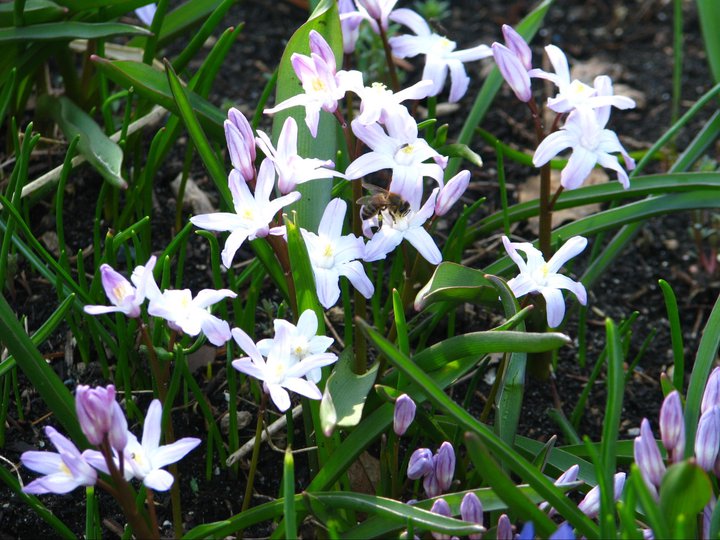
Flowers and bee
Showing posts with label Environment. Show all posts
Showing posts with label Environment. Show all posts
Tuesday, October 09, 2007

Sunday, March 25, 2007
Flower Confidential
Be careful the next time you buy that cheap floral bouquet. Do you know where your flowers have been? And what they have been dipped in? You might want to read Amy Stewart's book about the floral industry - Flower Confidential. This is a well written book that takes the reader through the international market of cut flowers.
Some fun facts:
- Europeans buy more flowers per capita than folks in the United States - especially Germany and Switzerland.
-The United States' consumers may pay less for flowers than other countries - but there is a reason those flowers are cheap: they are not top quality and do not last as long.
- Most U.S. grocery stores have their floral areas in the worst possible place - near the produce area where the riping fruit and veggies produce ethylene. Ethylene - "which will cause downward bending of flower foliage, failure of buds to open, or open flowers to close or fall off. Florist greens will yellow, and leaves and berries will bend downward or fall off in the presence of ethylene. Damaged or diseased plant material also give off ethylene. " (from the USDA website) (Costco supposedly does a better job with their floral area than most!)
- Some foreign growers use pesticides that are banned in the United States. But try telling which flowers are which...
Stewart takes you to rose growers in Ecuador, the Miami airport's inspection area for cut flowers - where most of them are dipped in fungicide - remember that next time you take a sniff from cut flowers (most of which do not smell anyway), and the frenzied Dutch Flower auction which sets prices for most of Europe's flowers. She also writes about the growing movement for organic certification (most of Europe is already there) for flowers in the U.S.
This book is definitely worth a look if you are a flower lover. It will make you want to buy a bouquet - or run outside and cut your own. But be careful where and what you are buying.
Some fun facts:
- Europeans buy more flowers per capita than folks in the United States - especially Germany and Switzerland.
-The United States' consumers may pay less for flowers than other countries - but there is a reason those flowers are cheap: they are not top quality and do not last as long.
- Most U.S. grocery stores have their floral areas in the worst possible place - near the produce area where the riping fruit and veggies produce ethylene. Ethylene - "which will cause downward bending of flower foliage, failure of buds to open, or open flowers to close or fall off. Florist greens will yellow, and leaves and berries will bend downward or fall off in the presence of ethylene. Damaged or diseased plant material also give off ethylene. " (from the USDA website) (Costco supposedly does a better job with their floral area than most!)
- Some foreign growers use pesticides that are banned in the United States. But try telling which flowers are which...
Stewart takes you to rose growers in Ecuador, the Miami airport's inspection area for cut flowers - where most of them are dipped in fungicide - remember that next time you take a sniff from cut flowers (most of which do not smell anyway), and the frenzied Dutch Flower auction which sets prices for most of Europe's flowers. She also writes about the growing movement for organic certification (most of Europe is already there) for flowers in the U.S.
This book is definitely worth a look if you are a flower lover. It will make you want to buy a bouquet - or run outside and cut your own. But be careful where and what you are buying.
Wednesday, June 21, 2006
Think Globally - Act Locally
Wanda Urbanska and her husband, Frank Levering, wrote a book called Simple Living: One Couple's Search for a Better Life, when they moved from L.A. to Virginia. They had a hand in starting the current "simplicity" movement. They now have an orchard in North Carolina and have a show called Simple Living on PBS. Their latest book, Nothing's Too Small to Make a Difference continues their message of keeping thing simple and worrying about their impact on the environment.
This book may be a re-run to others who have previously read other books on simple living, but I felt it was a great reminder and inspiration to those of us who are trying to do what little we can. Wanda points out that - yes - little things do add up - when she talks about taking a travel cup to get her coffee from the local shop versus the plastic cup. She sat down one day and added up all the cups she would have used and it was quite a lot. Sometimes I think that we need the reminder that choosing to make a smaller footprint on the earth, create less garbage, buy less junk, create more beauty IS worth it. This book is a positive introduction to that, it has some first-rate tips, and it is a good update on the couple that helped the "movement" along.
This book may be a re-run to others who have previously read other books on simple living, but I felt it was a great reminder and inspiration to those of us who are trying to do what little we can. Wanda points out that - yes - little things do add up - when she talks about taking a travel cup to get her coffee from the local shop versus the plastic cup. She sat down one day and added up all the cups she would have used and it was quite a lot. Sometimes I think that we need the reminder that choosing to make a smaller footprint on the earth, create less garbage, buy less junk, create more beauty IS worth it. This book is a positive introduction to that, it has some first-rate tips, and it is a good update on the couple that helped the "movement" along.
Subscribe to:
Posts (Atom)